
I stood there, hip-deep in a Tuesday night cleanup, pushing against my dishwasher door with the desperation of a man trying to hold back a dam. Click. Nothing. Click. Still popping open. It’s that visceral moment of appliance betrayal we’ve all felt—usually right after a heavy dinner when you just want to sit on the couch and forget the world exists. I remember one time, about five years ago, I actually tried to use a heavy kitchen chair to wedge the door shut. Not only did it leak everywhere, but it also nearly burned out the motor because the seal wasn’t tight enough to engage the sensor. It was a rookie move. We are not doing that today.
Stop Fighting Your Dishwasher Door
A door that won’t latch isn’t just annoying; it’s a safety mechanism doing its job. If that sensor doesn’t feel the ‘click,’ your kitchen stays dry, but your dishes stay dirty. Most people immediately panic and think they need a whole new machine, but usually, it’s something much simpler than a complete mechanical failure. Before you start scheduling your appliance repair for same-day service in 2025, let’s look at the physical alignment. Often, the unit has shifted slightly over time due to the vibration of those heavy cycles. I learned the leveling secret for a silent dishwasher cycle applies here too; if the feet aren’t perfectly even, the latch will never line up with the strike plate properly.
Is this actually a DIY job or am I going to flood the house?
You might be skeptical. I get it. Water and electricity are a scary combo for anyone who isn’t a licensed plumber. But honestly, most latch issues are mechanical, not electrical. According to experts at Consumer Reports, a dishwasher that won’t close is frequently caused by a simple misaligned strike plate or a worn-out plastic handle that can be replaced for less than the cost of a pizza.
My Duct Tape Disaster and What It Taught Me
Early in my ‘handyman’ journey, I thought I could outsmart the machine. I used heavy-duty tape to keep the latch engaged while I went to bed. Big mistake. The steam from the hot water quickly melted the adhesive, and the door popped open mid-cycle while I was asleep. I spent two hours the next morning mopping up a lake. That taught me that the latch is directly linked to the secret switch inside your dishwasher that stops the overflow. If you force it, you’re bypassing a critical safety feature designed to protect your floors. Sometimes, the issue is actually the door tension. I’ve found that the spring adjustment that keeps your dishwasher door from slamming can sometimes pull the door too tight or unevenly, preventing the latch from catching. Have you ever found yourself propping a chair against your dishwasher just to get through a load of dishes? Drop a comment and tell me your most ‘creative’ appliance fail. We’re going to get this sorted properly today so you can stop wrestling with your kitchen and start relaxing.
Look for the Hidden Spatula Sabotage
First, we check the obvious. Open the door wide and pull both racks out completely. I once spent twenty minutes cursing a high-end unit, sweating over a screwdriver, only to realize a rogue silicone spatula had slipped behind the bottom basket. It was acting like a spring-loaded doorstop. Even a tiny piece of plastic from a broken lid can get lodged in the track. If your racks aren’t gliding back flush against the rear wall, the door is fighting physics. This is often why the filter error that makes your modern dishwasher stop mid-cycle triggers—the door loses contact for a millisecond, and the brain of the machine thinks the kitchen is about to flood.
Line Up the Strike Plate or Face the Leak
If the path is clear, look at the very top of the dishwasher tub. That metal “U” or hole is the strike plate. Over years of slamming the door, the screws holding it can vibrate loose. I’ve seen plates shifted just three millimeters to the left, which is enough to make the latch bounce off instead of clicking in. Grab a Torx or Phillips head screwdriver and ensure it’s centered and tight. This is a fundamental part of an expert guide to appliance repair and installation today; if the frame isn’t rigid, the latch won’t bite. 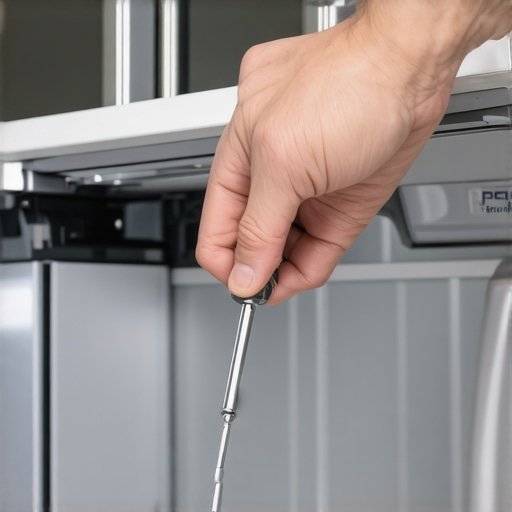
Reseat the Gasket Before It Pushes Back
Your dishwasher seal is a thick rubber gasket that creates a watertight vacuum. If it has pulled out of its groove even slightly, it becomes a literal cushion that prevents the door from reaching the latch. I remember a job where the homeowner had replaced the seal but didn’t press it into the corners properly. It looked fine, but the door felt “spongy.” Just like the simple gasket cleaning that stops fridge door sweating, you need to run your thumb along the entire track to ensure it’s seated deep. If the seal is old and brittle, it might be time for a fresh one to restore that satisfying click.
The Broken Handle Heartbreak
If the door closes but the handle feels limp or doesn’t spring back, the internal plastic pivot has likely snapped. This happened to me on a holiday weekend, and I ended up having to manually trip the sensor with a toothpick just to get the gravy off the plates—a move I don’t recommend because it bypasses safety. If you’re in this boat, you’re looking at a handle assembly replacement. While you’re in there, check the wiring; sometimes a loose connection mimics a mechanical failure. If the electronics are acting up, you might need to look into scheduling your appliance repair for same-day service in 2025 to get a pro to test the control board. Often, the latch itself is fine, but the micro-switch behind it has burnt out, refusing to tell the machine the door is safe to lock.
Stop Assuming Every Mechanical Failure is a Warranty Win
Most folks think that as long as they have a piece of paper from the manufacturer, they’re golden. But here’s the contrarian truth: a factory warranty isn’t a blank check. I’ve seen homeowners get denied coverage because they used high-sudsing detergent that caused residue buildup, eventually gumming up the latch mechanism. You have to understand the difference between a factory warranty and a service contract before you even pick up a screwdriver. One covers manufacturing defects, while the other is often more lenient on wear and tear. If you’re banking on maximizing your appliance warranty during emergency repairs, you need to be able to prove you haven’t been ‘creatively’ bypassing safety sensors with toothpicks or tape. Have you ever fallen into this trap? Let me know in the comments.
Is Your DIY Repair Actually Voiding Your Coverage?
This is the ultimate ‘oops’ factor for the weekend warrior. Under the Magnuson-Moss Warranty Act, manufacturers generally cannot void your entire warranty just because you performed your own repair or used a third-party part. However—and this is a big ‘however’—if your DIY attempt to fix a strike plate actually cracks the plastic inner tub, that specific damage won’t be covered. Before you dive in, it is vital to verify your new appliance is covered under the original warranty and document the state of the machine. I always tell people to take a time-stamped photo of the faulty part before they touch it. This simple step is a core part of an expert guide to appliance repair and installation today because it protects you from a technician claiming you caused the break.
Why Same-Day Service is Often a Rescue Mission, Not Just a Fix
People often get frustrated when they call for same-day appliance repair quick solutions with warranty support and the tech doesn’t have the exact, rare circuit board in the van. The nuance here is that ‘same-day’ usually refers to the diagnostic and the stabilization of the emergency. If your dishwasher door won’t close, the pro’s job that day is to ensure it’s not leaking and to order the specific OEM part that maintains your safety rating. In my experience, trying to force a ‘same-day’ permanent fix with a ‘universal’ latch is a recipe for a house fire. Universal parts often lack the precise heat resistance required for high-temp sanitizing cycles. If you want affordable same-day appliance fixes with warranty benefits, be prepared for a two-step process: the ‘stop the bleeding’ visit and the ‘final restoration’ visit. Don’t let your impatience compromise the integrity of your kitchen’s most hardworking machine.
The Small Kit That Saves You Hundreds
If you want to stop being at the mercy of a repairman’s schedule, you need a specialized toolkit. I don’t mean a massive chest in the garage; I mean a small, dedicated drawer in your kitchen. Personally, I never touch a dishwasher without my Klein Tools 11-in-1 multi-bit driver. Why? Because these machines use a frustrating mix of Phillips, flathead, and Torx screws (specifically T15 and T20), and switching tools every thirty seconds is how you lose your patience and strip the hardware. Another non-negotiable is a basic digital multimeter. If you can’t verify that your door switch has continuity, you’re just guessing. This level of preparation is what separates a frustrating weekend from the success found in an expert guide to appliance repair and installation today. According to the Association of Home Appliance Manufacturers (AHAM), most high-end dishwasher doors are cycle-tested for 10 to 15 years of standard use, which means if your latch is acting up in year three, it’s usually a maintenance or installation oversight, not a death sentence for the machine.
How do I maintain my dishwasher latch over time?
Longevity in the kitchen isn’t about luck; it’s about mechanical hygiene. First, you have to tackle the invisible enemy: mineral buildup. I’m a huge fan of the hard water trick for keeping your dishwasher clean. Calcium deposits don’t just spot your glasses; they crystallize inside the latch mechanism and around the gasket, making the rubber stiff and the plastic brittle. Every six months, I also suggest checking the hinge cables. These tensioners ensure the door closes squarely. If one side is tighter than the other, the latch will eventually twist out of alignment. This is the maintenance move that extends the life of your high efficiency washer and dishwasher alike—balancing the load so the machine doesn’t have to work against its own frame.
What the future holds for your kitchen sensors
Looking ahead, I predict we are moving toward ‘smart’ latches that utilize electromagnetic induction rather than plastic physical hooks. We’re already seeing this in high-end refrigeration, and it’s only a matter of time before dishwashers eliminate the ‘click’ altogether in favor of a silent, motorized seal. This will make how to ensure reliable appliance installation in 2025 even more critical, as electrical calibration will replace simple screwdriver adjustments. Until then, you need to rely on warranty-backed appliance services you can rely on when the sensors go dark. Avoid the hidden risk of third-party parts for smart fridges and dishwashers; if a cheap latch doesn’t communicate with the motherboard correctly, the machine simply won’t run. Try this: tonight, take a damp microfiber cloth and wipe the strike plate and the latch hook. You’d be surprised how much food grease migrates there, causing the latch to slip and the cycle to fail mid-wash.
What I Learned After Three Flooded Kitchens
I used to think force was the answer. If the door didn’t click, I’d just slam it harder. That’s a myth that cost me a new control board and a lot of frustration. Here is the real wisdom I’ve picked up over the years: if it doesn’t click with a pinky finger’s worth of pressure, something is physically misaligned. Never ignore a ‘spongy’ feel; that’s the gasket telling you it’s about to fail or pop out of its track. Finally, I realized that maximizing your appliance warranty during emergency repairs isn’t about being lucky; it’s about having your maintenance photos and paperwork ready before the tech even arrives at your door.
The Drawer Every Homeowner Needs
You don’t need a professional workshop to handle most latch issues. I swear by a dedicated ‘appliance kit’ that stays right in the kitchen. My must-haves include a set of long-reach Torx drivers—because those latch screws are always buried deeper than you think—and a digital multimeter to test for continuity in the door switch. For the bigger hurdles where electronics are involved, I keep the contact info for warranty-backed appliance services you can rely on taped to the inside of my sink cabinet. Knowing when to stop and call for an expert guide to appliance repair and installation today is the ultimate pro move that saves your floor and your budget.
Take Back Your Kitchen Peace
There is a specific kind of satisfaction that comes from hearing that crisp, clean click of a perfectly aligned dishwasher door. It’s the sound of a job well done and a night spent relaxing on the couch instead of mopping up a leak. Whether you choose to DIY the strike plate alignment tonight or decide on how to ensure reliable appliance installation in 2025 by hiring a pro for a fresh start, you’re making your home run smoother. You’ve got this. Don’t let a small piece of plastic or a shifted screw ruin your week. Have you ever had a ‘simple’ fix turn into a whole weekend project? I’d love to hear your stories in the comments below!