
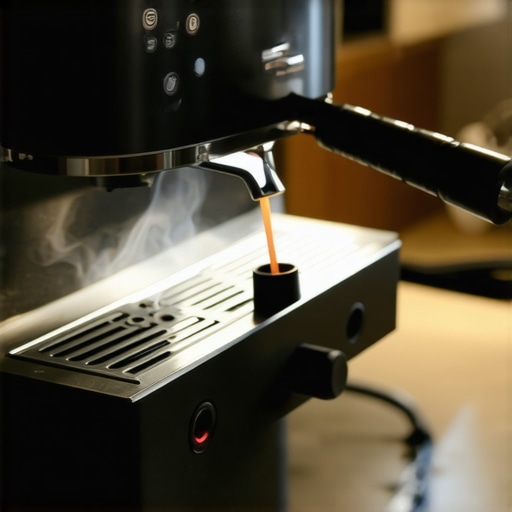
I stood there, bleary-eyed and desperate for caffeine, staring at the lifeless digital display of my Breville. It wasn’t a fuse. It wasn’t the outlet. It was the $5 power strip I’d tucked behind the toaster, now slightly warped and smelling of regret. I’d spent more on single-origin beans that month than I had on the very thing protecting my machine’s delicate internal circuitry. It was a classic ‘I’ll get to it later’ mistake that nearly cost me a small fortune in repairs. If you’ve got your high-end brewer daisy-chained to a generic office strip, you’re playing a dangerous game with your morning routine and your wallet. Today, I’m going to show you why this common setup is a ticking time bomb for your kitchen and how to fix it before the damage is permanent.
Stop Using Office Supplies for Kitchen Appliances
Most people don’t realize that a high-end espresso machine is basically a powerful space heater that happens to make coffee. When those heating elements kick in to reach 200 degrees, they pull a massive amount of current. Standard power strips are designed for lamps and phone chargers, not the heavy-duty draw of a professional-grade boiler. I learned this the hard way when I realized the power cord error that voids your fridge warranty is actually very similar to what happens when you choke the power to your coffee station. You’re starving the machine and overheating the strip simultaneously. According to the Electrical Safety Foundation (ESFI), nearly 3,300 home fires are started by extension cords and power strips annually, often due to overloading. For us coffee nerds, the risk isn’t just a fire; it’s the ‘brownout’ effect. When the voltage drops because the strip can’t handle the load, the sensitive control boards inside your machine can fry. I’ve seen beautiful machines turned into expensive paperweights because of a melted capacitor that wouldn’t have blown if it had a direct line to the wall. If you’re worried about your setup, you might need to look into an expert guide to appliance repair and installation today to see how to properly wire a high-draw kitchen area.
Is a ‘heavy duty’ surge protector actually enough?
You might be thinking, ‘But I bought the one with the gold-plated logo!’ and honestly, I thought the same. But here’s the kicker: even the beefiest surge protectors have a limit on sustained amperage. Most kitchen circuits are 15 or 20 amps, and your machine likely wants almost all of that. When you share that strip with a grinder or a milk frother, you’re asking for trouble. Have you ever noticed your lights flicker when the heater kicks on? That’s your first warning sign. I ignored it for weeks until my machine started throwing ‘Error 01’ codes that weren’t in the manual. Luckily, I found warranty-backed appliance services you can rely on, but not everyone gets that second chance. Have you noticed your power strip getting warm to the touch after brewing a couple of lattes? Tell me if you have, because that’s a red flag you can’t afford to ignore. We’re going to fix your workflow today so you never have to smell burning plastic with your morning roast again. Checking your maintenance contract clause that saves you on labor costs is a good start, but prevention is much cheaper than a technician’s visit.
Check the Rating Plate Before You Plug Anything In
Your machine has a secret ID tag, usually tucked under the base or behind the water reservoir. This sticker tells you exactly how many Watts or Amps the unit pulls. If your machine is rated for 1500W and your power strip is a generic 10A model from a hardware store, you are already in the red. I remember trying to run my dual-boiler machine and a professional-grade grinder on the same cheap strip; within ten minutes, the plastic felt soft to the touch. It was not just warm; it was physically deforming. This is why you must match your power source to the actual draw. When dealing with high-voltage kitchen equipment, following a protocol for how to ensure reliable appliance installation in 2025 is the only way to sleep soundly. High-draw appliances are essentially small heaters, and they deserve a dedicated connection.
Look for the Tell-Tale Signs of Heat Damage
Don’t just wait for a fire to realize something is wrong. Periodically inspect the prongs of your machine’s plug and the outlet itself. If you see any brown or blackish tinges on the plastic, or if the outlet looks slightly warped, the internal connection is failing. I once ignored a faint ‘ozone’ smell for a week, thinking it was just the machine ‘breaking in’ after a deep clean. In reality, the internal contacts of the cheap strip were arcing every time the heater kicked on. This kind of negligence leads directly to the hidden costs of diy repairs on warranty covered items, where you end up paying for a full control board replacement because you tried to save ten dollars on a cord. If the power cord feels like a warm gummy worm after a long brewing session, unplug it immediately.
Get the Correct Wire Gauge for High-Power Brewing
If your kitchen layout forces you to use an extension or a specific surge protector, it must be a heavy-duty 12-gauge or 14-gauge cord. Most people do not realize that the correct wire gauge for your new electric dryer logic applies to smaller, high-wattage appliances as well. Thinner wires have higher resistance, which generates dangerous heat. Think of it like trying to force a gallon of water through a cocktail straw; eventually, the pressure causes a failure. A 12-gauge cord can safely handle the 15-20 amp spikes your espresso machine hits when the steam boiler and brew boiler engage simultaneously. Anything thinner is a gamble with your home’s safety and your machine’s sensitive electronics.
Keep the Receipts and the Maintenance Logs
Manufacturers are becoming increasingly strict about detecting electrical abuse during service. If you send a machine in for repair and the technician finds charred terminals or melted internal wiring, they will know you used an inadequate power source, and your warranty claim will be rejected. This is why knowing how to prove periodic maintenance to keep your warranty valid is absolutely crucial. I keep a digital folder of every outlet upgrade and surge protector purchase I make for my kitchen. Having the one maintenance record that saves your appliance warranty claim ready to go can save you thousands in the long run. You are not just protecting a machine; you are protecting the investment you made in your daily coffee ritual and ensuring your kitchen remains a safe space.
Most people think that same-day service is the gold standard for every appliance failure. If your fridge stops cooling or your espresso machine goes dark, you want it fixed now. However, in the world of high-end brewing and sensitive kitchen electronics, the rush to find affordable same-day appliance fixes with warranty benefits can sometimes backfire if you aren’t careful. Here is the contrarian truth: a technician who promises to fix a specialized control board in twenty minutes without ordering OEM parts is often just bypassing a safety fuse or using a generic ‘workaround.’ I once had a tech offer to ‘jump’ a thermal limiter just to get me back to brewing. It worked for an hour, but it fundamentally altered the machine’s safety profile and could have started a fire.
The ‘oops’ factor here is the massive distinction between a quick fix and a compliant one. When you prioritize speed over precision, you risk hitting the wear and tear clauses that might void your warranty. Many modern machines have internal ‘black box’ logs that record event faults. If a technician performs an unauthorized modification during same-day appliance repair, those logs will show the deviation. When the machine inevitably fails again, the manufacturer will see the non-standard repair and deny your claim. Have you ever fallen into this trap of choosing the fastest repair over the most thorough one? Let me know in the comments.
Can a same-day fix actually void your manufacturer agreement?
The short answer is yes, specifically if the provider isn’t certified for your specific brand. There is a significant difference between a manufacturer warranty and a service contract. A manufacturer warranty often requires specific diagnostic protocols that take time. According to a technical report by the National Institute of Standards and Technology (NIST) on electronic component reliability, heat-stressed circuits—common in high-wattage kitchen gear—require specific impedance matching that generic parts simply cannot provide. If your ‘expert’ swaps in a generic capacitor to save time, they might restore power, but they are effectively ending your relationship with the manufacturer’s support team.
This is why you need to know exactly what to expect from same-day appliance repair experts before they even open the housing of your machine. Genuine experts will have the diagnostic tools to read those internal error codes rather than just poking around with a multimeter and a soldering iron. We often trade long-term reliability for a quick caffeine fix, and it’s a trade I’ve regretted more than once. Always ask if the parts being used are OEM-certified before the work begins; otherwise, your ‘same-day fix’ might turn into a ‘next-month replacement’ that comes entirely out of your own pocket.
I keep a Fluke 117 digital multimeter in my kitchen drawer right next to the whisk and the microplane. People think I’m obsessive until their thousand-dollar espresso machine stops heating and they realize they’ve been blaming the machine for a $20 outlet failure. To maintain a truly reliable setup, you need to move beyond just ‘wiping it down’ and start thinking like a technician. I use this specific multimeter because of its non-contact voltage detection; it allows me to quickly check if my power strip is actually delivering the 120V it promises before I even think about calling for same-day appliance repair. If you are not checking your voltage drops, you are just guessing.
How do I maintain my high-end brewer over time?
The single most important routine I’ve adopted is the ‘Three-Month Audit.’ Every quarter, I pull my machine away from the backsplash to inspect the cord for heat stress and replace the group head gasket. I also test the water hardness. We often think about scale in terms of plumbing, but for an espresso machine, it is a death sentence. The Specialty Coffee Association (SCA) Water Quality Standard emphasizes that total dissolved solids (TDS) should stay around 150 mg/L to prevent scale while preserving flavor. If you ignore this, you’ll end up with a clogged heat exchanger, a problem so deep it often requires maximize your appliance warranty during emergency repairs protocols just to get a technician to touch the internals. I’ve seen the water softener setting that is ruining your dishwasher also apply here—too soft, and your sensors won’t detect water; too hard, and you’re brewing a rock. Keep a log of your descaling cycles. It’s the only way to avoid a mid-morning breakdown that forces you into scheduling your appliance repair for same-day service in 2025 when parts might be backordered.
Looking ahead, the next big trend in kitchen maintenance is the integration of smart breakers and predictive power monitoring. By 2026, I expect most high-end kitchens will use AI-driven circuit breakers that can detect the specific ‘signature’ of a failing heating element before it actually pops. This transition toward proactive safety is why how to ensure reliable appliance installation in 2025 is becoming such a hot topic. We are moving away from the ‘wait until it breaks’ mentality toward a world where your phone tells you your brew boiler is drawing 5% more amperage than normal, signaling a need for a deep clean. If you’re setting up a new station, always look for fast-trustworthy-appliance-installation-near-you to ensure your wiring meets the NFPA 70 (National Electrical Code) requirement for dedicated 20-amp small-appliance branch circuits. Without that dedicated line, your smart machine is essentially running on a handicap. My best advice? Go buy a simple $15 outlet tester today and check every plug in your kitchen; it’s the fastest way to find a loose neutral before it fries your electronics.
Lessons Learned from a Fried Circuit Board
After years of tinkering, I’ve realized that electrical wear and tear is invisible until it becomes expensive. One thing that surprised me was how often voltage drops mimic mechanical failures. If you see your machine struggle to reach pressure, it might not be the pump; it could be the power strip. I also learned that warranty-backed appliance services you can rely on are worth their weight in gold when you’re dealing with proprietary boards. Never assume a working outlet is a safe outlet—test it when the machine is under full load. Another lightbulb moment for me was realizing that the secret to cleaning coffee grinders without water actually helps prevent electrical shorts too, as moisture and high-voltage grinders are a recipe for disaster. If your setup feels like a puzzle, consulting an expert guide to appliance repair and installation today can save you from the expensive mistakes I experienced early on.
Tools That Saved My Kitchen Workflow
I don’t go anywhere without my Fluke 117 Multimeter; it’s the only way to know if your wall is actually giving you 120V consistently. I also highly recommend switching to 12-gauge industrial extension cords if you can’t reach a wall outlet directly; they handle the heat that melts standard office strips instantly. For the water side, the SCA Water Quality Toolkit is essential to prevent the scale that leads to needing affordable same-day appliance fixes with warranty benefits later on. Lastly, keep a Kill-A-Watt meter handy to see exactly how much your dual-boiler machine is pulling during the warm-up phase so you never overload a circuit again.
Take Control of Your Coffee Ritual
You’ve invested a lot in your morning routine, so don’t let a cheap power strip be the weak link in your chain. By focusing on how to ensure reliable appliance installation in 2025, you’re not just making better coffee—you’re protecting your home and your investment. If you ever notice symptoms like why your toaster oven heating elements only glow halfway, apply that same diagnostic logic to your espresso machine immediately to catch failures before they happen. Your gear deserves a stable foundation to perform its best every single morning. Have you ever noticed your kitchen lights dim when your espresso machine starts heating up? Let me know in the comments below!