
I remember the day I finally upgraded to a high-efficiency front-loader. I was so excited to ditch my old, rattling top-loader that I barely glanced at the manual before shoving the new unit into place. I threw in a load of towels, hit start, and ten minutes later, it sounded like a freight train was crashing through my laundry room. The machine was literally six inches away from the wall, vibrating so violently I thought the floor was going to give way. I panicked, thinking I’d bought a lemon. It was only after a frantic call to a buddy that I realized I’d made the most common, yet most destructive, rookie error: I left the shipping bolts in. If you’ve ever wondered why your washer is jumping across the laundry room floor, you are likely staring down the same mistake I made. Today, I’m going to save your floors, your sanity, and your warranty by explaining why those bolts are the silent killers of brand-new appliances and how you can fix it before your first load becomes your last. We are going to dive into the specifics of reliable appliance installation so you don’t end up needing same-day appliance repair before your machine is even a week old.
Those Steel Rods Are Not Part of the Permanent Design
I’ll be the first to admit that I thought I knew better than the instruction manual. Most of us just want that fresh-scented laundry immediately! But those shipping bolts are designed strictly to keep the heavy drum from banging around during its journey in a delivery truck. Once the machine is in your home, those bolts turn the washer into a rigid, vibrating block of destruction. According to research from Consumer Reports, failing to remove these supports can cause permanent damage to the outer tub and suspension system within just one or two uses, which often leads to a nightmare scenario where your warranty claim is denied because of improper installation. This isn’t just about a noisy machine; it’s about preventing a total mechanical meltdown. I learned the hard way that skipping a five-minute task can lead to a thousand-dollar mistake. Trust me, you don’t want to be the one explaining to a technician why your machine is in pieces because you forgot to pull out four pieces of steel.
Is this shipping bolt thing actually a big deal?
It sounds a bit dramatic, doesn’t it? You’d think a modern machine could handle a few bolts. But consider the physics: a drum spinning at 1,200 RPM needs to move freely on its internal springs and shocks to absorb energy. When you bolt it to the frame, all that kinetic energy is transferred directly into the chassis, the bearings, and your home’s subfloor. I’ve seen people crack their expensive tiles and snap internal plastic housings all because they were in too much of a rush to check the back of the unit. If you’re worried about your setup, it’s always worth reviewing expert installation guides before hitting the start button. Have you ever turned on a new appliance only to realize something was horribly wrong within seconds? Tell me your first-day disaster stories—I promise I won’t judge! To keep your peace of mind, make sure to maximize your appliance warranty by documenting your setup process. Now, let’s look at exactly where these bolts hide and how to remove them without breaking a sweat.
To get started, you need to pull your machine far enough away from the wall so you can comfortably access the back panel. This is where those heavy-duty steel rods are hiding. Most modern front-loaders have between three and five bolts that pass through the rear of the cabinet into the drum assembly. You’ll usually see plastic caps covering them. If you try to run the machine with these in place, you’re looking at a disaster that even warranty-backed appliance services you can rely on might struggle to fix if the frame gets warped.
Look for the Four Plastic Caps on the Back
Once you’ve spotted the bolts, grab a wrench. Most manufacturers include a specialized flat wrench in the packaging, but a standard 10mm or 13mm socket wrench works much better. I once tried to brute-force a bolt with a pair of rusty pliers because I was too lazy to go to the garage for my socket set. I rounded off the edges of the bolt head so badly I had to use Vise-Grips and a lot of colorful language to get it out. It turned a five-minute job into an hour-long ordeal of sweat and frustration. Don’t be me—use the right tool from the start to ensure fast trustworthy appliance installation near you without a trip to the hardware store for extraction tools.
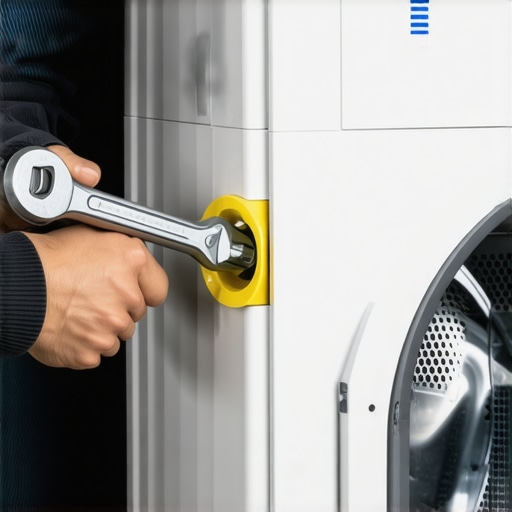
After you unscrew the bolts, you’ll notice a long plastic spacer or sleeve comes out with them. It’s crucial to remove the entire assembly, not just the metal bolt. If the plastic sleeve falls inside the machine, don’t panic, but you will need to fish it out so it doesn’t rattle against the motor. If you notice any damage during this process, you should immediately how to document a dead on arrival appliance for a full refund before you proceed further.
Keep Your Bolts in a Ziploc Bag for Your Next Move
Here is a pro tip that most people ignore: do not throw those bolts away! Tape them to the back of the machine or put them in a labeled bag in your junk drawer. If you ever move houses, you must reinstall these bolts to protect the suspension. Transporting a front-loader without them is the fastest way to turn a working machine into a pile of scrap metal. This simple step is a core part of how to ensure reliable appliance installation in 2025 and beyond. I’ve seen friends lose their entire investment because a moving company hit one pothole and snapped the internal shocks of an unbolted washer.
Get It Perfectly Level Before You Add the Detergent
Even with the bolts out, a machine that isn’t level will still dance. Use a bubble level on the top of the unit, checking both side-to-side and front-to-back. You can adjust the height by turning the threaded feet at the corners. If you’re struggling with a slight wobble, check the one screwdriver turn that levels a rattling washer to see how a minor adjustment makes a massive difference. If your machine is still vibrating excessively after leveling, you might be dealing with the 15 part that fixes a shaking washing machine, such as worn shock absorbers or a loose counterweight, though this is rare on brand-new units.
Most people view same-day service as a luxury for the impatient. I used to think the same until a technician explained that same-day appliance repair is actually a critical defensive maneuver for your wallet. If you let a vibrating washer or a leaking fridge sit for a week, you aren’t just deal with an inconvenience; you are allowing ‘secondary damage’ to occur. Manufacturers often have clauses that negate coverage if the owner fails to mitigate further damage once a fault is known. According to experts at the Association of Home Appliance Manufacturers (AHAM), delayed attention to minor mechanical issues is a leading cause of catastrophic component failure that could have been avoided with affordable same-day appliance fixes.
Don’t Assume Your Service Contract Covers Everything
We often fall into the trap of believing that a ‘bumper-to-bumper’ warranty means we don’t have to worry about a thing. The reality is much more nuanced. There is a massive difference between a mechanical failure and what adjusters call ‘environmental factors.’ For instance, if your machine fails because of hard water buildup or because it was installed on an uneven subfloor, your claim might be dead on arrival. This is why I always emphasize the importance of an expert guide to appliance repair and installation. You need to prove that the machine was set up perfectly to survive a warranty audit. Even a minor oversight in how you handle the water lines can lead to a situation where the reason your warranty claim was denied is listed as ‘improper site preparation.’
Can a simple DIY adjustment actually void my factory protection?
It’s the question that keeps every weekend warrior up at night. The short answer: it depends on what you touch. Adjusting the leveling feet or cleaning a filter is fine, but breaking a factory seal on a control board or motor housing is the point of no return. If you are ever in doubt, it is safer to rely on warranty-backed appliance services you can rely on. They document the repair in a way that keeps your paper trail clean. I’ve seen homeowners try to save fifty bucks by fixing a small sensor themselves, only to lose three years of remaining coverage because they left tool marks on the internal chassis. Before you even think about opening the cabinet, make sure you have the warranty document you must save before discarding the box and check the fine print for ‘unauthorized repair’ clauses.
Documentation is Your Best Friend in a Dispute
One hidden nuance that most people miss is the ‘maintenance log’ requirement. Many high-end brands now require proof that you’ve performed basic upkeep, like running cleaning cycles or checking hoses. Without this, you may find yourself having to how to challenge a warranty claim rejection which is a long, uphill battle. Keep a simple folder or a digital log of every time you’ve inspected the unit. This is the one maintenance record that saves your appliance warranty claim when the manufacturer tries to blame ‘wear and tear’ for a premature failure. Always remember that the wear and tear clauses that might void your warranty are written in the manufacturer’s favor, so your goal is to prove you were the perfect owner. Have you ever fallen into this trap where a small DIY fix came back to haunt you? Let me know in the comments! If you’re currently facing a vibrating machine, don’t wait for it to get worse—look into fast trustworthy appliance installation near you to get it right the first time.
Why I Never Touch a Wire Without My Multimeter
I personally swear by a high-quality digital multimeter with an auto-ranging feature. If you’ve ever wondered why your oven won’t heat up or why your dryer just won’t tumble, you can spend hours guessing or two minutes checking the continuity of the components. I use mine to find the control board solder joint that kills your range without having to replace the entire expensive computer assembly. According to the GE Technical Service Guide for modern cooking products, over 30% of field failures are actually simple electrical connectivity issues rather than component meltdowns. By owning a tool that can verify voltage and resistance, you transform from a frustrated homeowner into a technician who knows exactly why a machine is failing. This level of precision is exactly what to expect from same-day appliance repair experts who value accuracy over parts-swapping.
How can I keep my appliances in peak condition over the years?
Maintaining a heavy-duty machine is less about heavy labor and more about consistent observation. I recommend a ‘quarterly audit’ where you spend thirty minutes checking the basics. Start by inspecting the water supply lines for micro-cracks and ensuring the drainage paths are clear of debris. It is vital to learn how to prove periodic maintenance to keep your warranty valid, as modern service providers often require a digital trail of these check-ups to honor expensive claims. If you notice a strange noise or a drop in performance, don’t wait for a total breakdown. Early intervention through scheduling your appliance repair for same-day service in 2025 ensures that a five-dollar seal doesn’t turn into a five-hundred-dollar motor failure. Documentation is the bridge between a ‘wear and tear’ rejection and a fully covered repair.
Smart Sensors Will Soon Handle the Diagnosis
We are rapidly moving toward a world where your refrigerator or washing machine will send a push notification to a local technician before you even realize there is a problem. Predictive maintenance is the next frontier, using AI to monitor vibration patterns and power draws. However, until every home is fully automated, the human element remains the most important factor in how to ensure reliable appliance installation in 2025. Even the smartest machine cannot fix itself if it was installed on an uneven floor or with restricted airflow. My advice? Get ahead of the curve right now by running the refrigerator thermostat test every diyer should know this weekend. It takes less than five minutes, costs nothing, and could prevent you from waking up to a puddle of melted ice cream and a voided warranty.
Hard-Earned Truths from My Laundry Room Disasters
After years of tinkering with everything from rattling dryers to flooded kitchens, I’ve realized that the most expensive failures usually start with a tiny oversight. First, never assume the delivery person did the leveling perfectly; always verify the feet yourself to prevent long-term frame stress. Second, keeping a dedicated folder for receipts and service logs isn’t just being organized; it is the one maintenance record that saves your appliance warranty claim when a manufacturer tries to blame lack of care. Finally, if you hear a strange clicking or humming, don’t wait for the weekend. Early intervention through same-day appliance repair can stop a small mechanical glitch from turning into a catastrophic structural failure.
My Go-To Gear for Stress-Free Ownership
I don’t believe in buying every gadget at the hardware store, but these four items are non-negotiable for my household. I always keep a pair of braided stainless steel hoses on hand to replace the cheap rubber ones that come in the box, as they are far less likely to burst and flood your home. I also rely on a high-quality magnetic level that sticks to the side of the machine for quick monthly checks. For more advanced troubleshooting, a digital multimeter is essential for verifying power flow, and a simple digital folder for photos of your setup ensures you maximize your appliance warranty if you ever need to file a claim. These tools are the backbone of a fast trustworthy appliance installation near you experience that lasts for years.
Take Charge of Your Home’s Hardworking Machines
Installing a new appliance should be a moment of excitement, not a source of lingering anxiety. By taking those few extra minutes to pull the shipping bolts, level the legs, and document your work, you are doing more than just laundry—you are protecting your home and your bank account. Mastery of your own appliances starts with knowing how to ensure reliable appliance installation in 2025. Don’t let the fear of a complex manual stop you from getting it right and keeping your peace of mind intact. Have you ever discovered a hidden setting or a ‘shipping secret’ after your machine was already running? Let me know in the comments below!